Rocket Money vs. YNAB: automation wins by a narrow margin
The better app depends on whether you want spending awareness or an active allocation practice.
Rocket Money beats YNAB in our 2026 comparison, 4.8/5 to 4.5/5. It wins for tracking, value, and ease, so it suits more people. YNAB remains the better pure budgeting system: choose it when assigning every dollar and actively covering tradeoffs are features you want, not chores you will avoid.
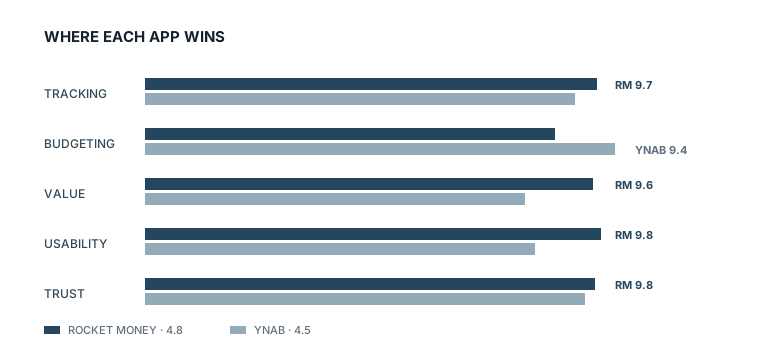
We ran both apps across the same core account mix and judged them with SaveHaven’s published weights. Rocket Money was used for six weeks and YNAB for eight, with an overlap that let us compare identical transactions, recurring charges, budget changes, and account refreshes. The winner is not universal: the scoring model favors sustainable daily utility, while individual households may reasonably put more weight on rigorous planning.
Category-by-category results
| Category | Rocket Money | YNAB | Winner |
|---|---|---|---|
| Daily tracking · 30% | 9.7/10 | 9.0/10 | Rocket Money |
| Budgeting & goals · 25% | 9.1/10 | 9.9/10 | YNAB |
| Value · 20% | 9.6/10 | 7.8/10 | Rocket Money |
| Usability · 15% | 9.8/10 | 8.7/10 | Rocket Money |
| Trust & support · 10% | 9.75/10 | 9.6/10 | Rocket Money |
| Weighted total | 95.5/100 · 4.8/5 | 90.0/100 · 4.5/5 | Rocket Money |
Tracking: Rocket Money finds the story faster
Rocket Money presents newly imported spending, category movement, account balances, and recurring charges with less setup. In our 427-transaction sample, its first-pass categorization was 92.7%. More important, correction rules reduced repeat cleanup. A user can open the app, review what changed, and leave in a few minutes.
YNAB imports reliably for supported institutions, but imported transactions are inputs to a budget rather than the finished product. Users approve, match, categorize, and assess whether categories remain funded. That process is excellent for awareness, yet it takes longer. Rocket Money wins tracking because it extracts a useful overview even when the user does not maintain a granular plan.
Budgeting: YNAB wins decisively
YNAB’s available-money logic is more rigorous. Every dollar receives a job; non-monthly expenses accumulate through targets; overspending requires money from another category. The method keeps a large checking balance from masquerading as disposable cash. It also handles true expenses—insurance, repairs, annual memberships—better than a conventional monthly limit.
Rocket Money supports category budgets and goals, but its system remains closer to monitoring. It shows whether spending is ahead or behind without requiring each dollar to be allocated first. For users who want guidance without a formal method, this is easier. For users who want the budget to govern decisions before they happen, YNAB is substantially better.
Price: compare starting cost and renewal cost
Rocket Money provides a real free tier. Premium follows a variable choose-your-price structure, with terms and billing cadence displayed during signup. Because offers can differ, users should record the checkout total and renewal date rather than rely on a headline monthly figure. The free tier makes account-connection testing possible before payment.
YNAB is simpler to price: $14.99 monthly or $109 annually before tax as of August 5, 2026. Direct signups receive a 34-day trial, and eligible students can apply for a free year. YNAB can justify its price for an engaged household, but Rocket Money earns the value win because meaningful use does not require a subscription.
Ease: Rocket Money asks less; YNAB teaches more
Rocket Money’s setup asks users to connect accounts, confirm categories, and choose which insights matter. The app begins producing a summary immediately. YNAB requires additional conceptual work: account money and category money are different views of the same dollars, credit-card spending moves cash toward a payment category, and targets have distinct behaviors.
YNAB’s education is unusually good, including written guides, workshops, and videos. Once learned, its interface supports fast keyboard and mobile workflows. Still, the learning investment is real. Rocket Money wins ease for a general audience; YNAB wins if “teaches a durable budgeting practice” is treated as the goal rather than a setup cost.
Subscriptions, goals, and debt
Rocket Money is the clear subscription tool. It identifies recurring charges, flags changes, and offers cancellation assistance to eligible Premium users. YNAB imports the same charges, but they look like other transactions unless the user creates a target or category.
YNAB is better for planned debt payments and sinking funds. A payoff category competes visibly with dining, travel, and every other job. Rocket Money can reveal cash to redirect, while YNAB excels at protecting the redirected cash once a decision is made.
Privacy and support: read both policies
Both services process sensitive financial information and may rely on account-linking partners. That convenience increases the number of systems involved in presenting a complete financial view. Use unique credentials, enable available multi-factor authentication, remove unused connections, and download only the data you need. Neither app eliminates the need to review bank and card statements.
The decision in one minute
- Choose Rocket Money if you want quick spending visibility, recurring-charge detection, a useful free tier, and low weekly maintenance.
- Choose YNAB if you want to assign every dollar, build sinking funds, and actively adjust a shared plan.
- Choose neither yet if a required bank fails to stay connected during the trial. Reliable data is more important than a feature checklist.
Read our full Rocket Money review and YNAB review for transaction samples and score calculations. The best budgeting apps ranking includes five additional choices for households that prioritize collaboration, lower cost, or manual envelopes. Our 60-day automation audit records the rules each app got right and wrong.
Frequently asked questions
Which is cheaper, Rocket Money or YNAB?
Rocket Money is cheaper to try because its free tier includes transaction tracking, basic budgets, and subscription visibility. Premium pricing varies at checkout. YNAB costs $14.99 monthly or $109 annually as checked August 5, 2026. Compare the full renewal amount, not a monthly equivalent attached to annual billing.
Which app is better for couples?
YNAB is better when a couple wants to plan every available dollar together and discuss tradeoffs. Rocket Money is better when the shared need is a consolidated view of accounts, spending, and recurring charges. Both require agreement about access and routines; neither app can make a partner participate in a budget.
Can I use Rocket Money and YNAB together?
Yes, but most households should not. Rocket Money can monitor recurring charges while YNAB manages allocation, yet duplicate notifications and two category systems add maintenance. Run them together only during a short comparison period or when Rocket Money’s subscription inventory solves a specific gap that is worth the extra account connection.
Which app is better for debt payoff?
YNAB is better for an active debt-payoff plan because funded payment categories make tradeoffs explicit. Rocket Money is better at finding recurring expenses that could be canceled to release cash. The right choice depends on whether your immediate problem is planning each dollar or locating spending that no longer reflects your priorities.