The quiet cost of convenience, annualized
A delivery order can feel like a $6 fee. Across a year, the receipt says something much larger—and more useful.
Twelve weeks of delivery receipts annualized to $2,412 in convenience costs. The visible delivery fees were only $364. Tips, service charges, menu markups, small-order fees, and memberships made up 85% of the premium. Cutting one of four weekly orders would preserve convenience while freeing roughly $603 a year at the observed average.
From April 27 through July 19, 2026, we collected every restaurant and grocery-delivery receipt for one two-adult household. There were 49 orders: 37 restaurant meals and 12 grocery baskets. We compared listed app prices with same-day pickup menus or in-store receipts where available, then separated food from the amount paid for delivery.
The fee is not “the fees”
A typical receipt presented a $2.99 delivery fee near the top. Lower down sat a service fee, tax, tip, and sometimes a small-order charge. The restaurant menu inside the app also averaged 7.8% above the pickup price across items we could match. No single line was shocking. The complete premium averaged $46.38 per week.
Multiplying twelve observed weeks by 52/12 produces $2,412 a year, rounded to the nearest dollar. This is not a prediction that every next week will match. It is a pace: if the routine remains unchanged, convenience consumes the equivalent of $201 per month.
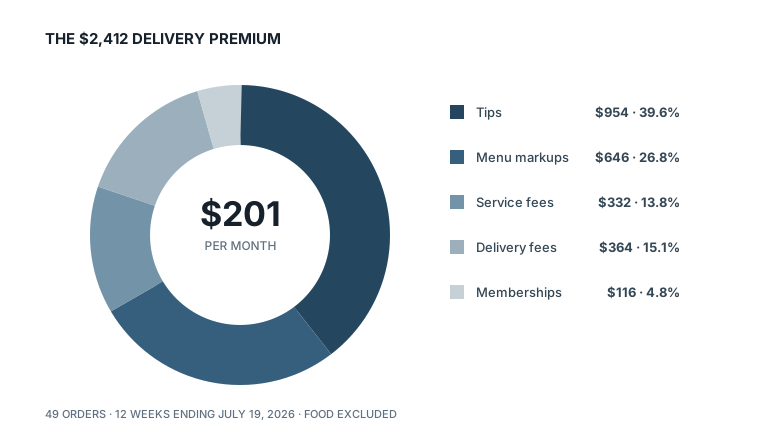
| Cost | 12 weeks | Annualized | Share |
|---|---|---|---|
| Tips | $220.24 | $954 | 39.6% |
| Menu and item markups | $149.08 | $646 | 26.8% |
| Service and small-order fees | $76.62 | $332 | 13.8% |
| Delivery fees | $83.96 | $364 | 15.1% |
| Memberships | $26.76 | $116 | 4.8% |
| Total premium | $556.66 | $2,412 | 100% |
Tips are labor cost, not the first cut
Tips were the largest line at $954 annualized. That does not make them the sensible place to save. The household chose a service that depends on a person driving, waiting, and carrying the order. Reducing the number of deliveries respects that labor more than preserving order frequency while squeezing the worker’s share.
The better target is order count and basket design. Fourteen orders carried a small-order or minimum-related penalty. Combining two grocery top-ups would have removed most of those charges. Six restaurant orders were within a 12-minute round-trip drive, making pickup a plausible substitute on days when time and mobility allowed.
Memberships helped—and encouraged use
The household paid for two delivery memberships. Their annualized $116 cost reduced some delivery and service fees, and canceling both without changing behavior would have increased the total premium. Yet the “$0 delivery fee” label also made an extra order feel prepaid. Membership value cannot be judged from fee savings alone if it changes frequency.
We tested a counterfactual using the same receipts. Keeping one membership, canceling the other, and moving one weekly restaurant order to pickup reduced the annualized premium by about $712. The household still retained roughly three deliveries a week. Convenience did not have to become prohibition.
The annual number changes the decision
$8.40 in fees on Tuesday competes with fatigue. $2,412 a year competes with other named priorities: a $2,000 emergency-fund increase, two $100 monthly debt payments, or a meaningful savings-rate step. Annualizing does not prove those uses are morally better. It restores the scale that checkout screens fragment.
Our 1% savings-rate analysis offers a useful comparison. On a $60,000 salary, one percentage point equals $600 annually. The observed delivery premium equals roughly four such points before tax effects. Cutting just one-quarter of it could fund the first point.
A calmer convenience budget
On July 20, 2026, the household set a $150 monthly convenience premium—not a food budget. That category includes tips, markups, and all platform charges. Food remains categorized as groceries or restaurants, preserving a view of what was eaten and what was paid to have it arrive. A separate premium makes the tradeoff visible without treating every delivered meal as a failure.
The rule is simple: use delivery intentionally when it protects scarce time, supports illness or caregiving, or makes a difficult week function. Use pickup, batch ordering, or a freezer meal when the app is merely the default response to not deciding. Our personal-finance glossary explains how this kind of irregular monthly limit fits cash flow and sinking funds.
What this audit cannot claim
This is one household and one 12-week window, not a national estimate. Local menus, tip practices, mobility, disability, caregiving, transit, and work hours change the real value of delivery. Same-day menu comparisons also miss temporary discounts and loyalty rewards. We counted only prices we could document.
The sobering number is useful because it is specific, not universal. Export or collect your own eight to twelve weeks of receipts, subtract the food-at-pickup amount, and multiply the remainder by 52 divided by observed weeks. The answer may justify the habit, change it, or simply turn an invisible convenience into an explicit line in the plan.
Frequently asked questions
How did you calculate $2,412?
The household paid $556.66 in tips, markups, fees, and memberships over 12 weeks. Multiplying by 52/12 gives $2,412, rounded.
Are delivery tips included?
Yes. Tips are part of the delivery premium, but we recommend reducing order frequency rather than cutting worker tips.
Does a delivery membership save money?
It can reduce per-order fees, but savings depend on order frequency and whether the membership encourages additional orders. Compare total annual cost, not a $0-fee label.