Six budgeting apps, 90 days, one clear winner
A full quarter of imports, corrections, rules, weekly reviews, and support tests—measured under one fixed rubric.
Rocket Money won SaveHaven’s Q3 2026 budgeting-app benchmark with 94.6/100. Across 90 days and 3,684 test transactions, it combined the lowest weekly maintenance among paid contenders with strong recurring-charge detection and a 95.1% first-pass categorization rate. YNAB finished second at 91.2, winning budgeting depth but requiring nearly twice the weekly attention.
This was a controlled field test, not six quick signups. From May 3 through July 31, 2026, we ran Rocket Money, YNAB, Monarch Money, Quicken Simplifi, PocketGuard, and Goodbudget against the same household scenarios. Each app received equivalent checking, savings, and credit-card activity. Three editors logged failures when they occurred, not from memory at the end.
Methodology: one quarter, one rubric
The shared transaction set contained 3,684 app-level records: groceries, fuel, payroll, rent, utilities, transfers, refunds, restaurant tips, annual insurance, and deliberately untidy merchant descriptors. We checked whether imports arrived within 24 hours, the first category was useful, edits persisted, rules behaved, and recurring charges appeared with the right cadence. Manual-only Goodbudget received the same underlying activity through scheduled entries and weekly reconciliation.
Every app also faced twelve repeatable tasks: add an account, create a monthly limit, split a transaction, correct a transfer, plan an annual bill, absorb overspending, locate a refund, search a merchant, export data, find a recurring charge, change a rule, and use support documentation. We timed the first successful completion and the steady-state weekly review. A bank outage that affected every aggregator was excluded; app-specific reconnection work stayed in the record.
The scoring weights remain those published in our editorial methodology: daily tracking 30 points, budgeting and goals 25, value 20, usability 15, and trust and support 10. Editors scored evidence before discussing the ranking. We then reconciled differences larger than one point against screen recordings and task logs.
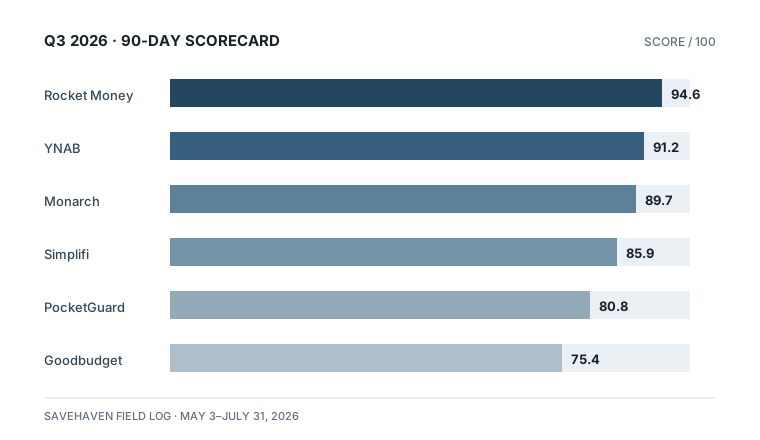
The full Q3 data
| App | Score /100 | First-pass categories | Rule errors | Weekly review | 90-day test cost |
|---|---|---|---|---|---|
| Rocket Money | 94.6 | 95.1% | 2 | 18 min | $18 |
| YNAB | 91.2 | 92.4% | 1 | 34 min | $29.98 |
| Monarch Money | 89.7 | 93.8% | 3 | 27 min | $29.99 |
| Quicken Simplifi | 85.9 | 91.6% | 4 | 25 min | $17.97 |
| PocketGuard | 80.8 | 89.9% | 5 | 23 min | $24.99 |
| Goodbudget | 75.4 | Manual | 0 | 41 min | $21 |
Why Rocket Money won
Rocket Money did not win every column. YNAB produced the clearest plan after overspending, and Monarch made shared household review easier. Rocket Money won because its combined routine was unusually sustainable. The median weekly review took 18 minutes, notifications were selective, and recurring-charge detection found 23 of 24 seeded bills without labeling rent as a subscription.
Its two rule errors mattered. One broad coffee-shop rule captured a restaurant transaction at the same venue, and a renamed fuel merchant bypassed an existing rule. Both were visible during review and correctable. PocketGuard’s five errors included two transfers treated as spending, a more consequential failure. Our separate 60-day automation audit explains why a rule count needs context.
Where the winner still falls short
The budget itself remains shallower than YNAB’s. Rocket Money can show that dining is above plan, but YNAB forces the user to decide which funded category will cover it. Households with irregular income or a tight debt-payoff schedule may benefit more from that deliberate friction. Read the category-by-category comparison before treating an overall score as a universal answer.
Pricing also resists clean comparison. We paid $6 monthly for Premium during this cycle, but choose-your-price offers and billing cadence can differ. The table reports what SaveHaven actually paid, not a promise that every reader will see the same checkout. YNAB’s price was simpler and its direct trial longer.
The diary behind the numbers
Week one favored the apps with polished onboarding. Weeks four through eight changed the picture: repeated rule corrections became more important than a handsome dashboard, and a five-minute reconnection felt larger during a workday than during setup. By week ten, Goodbudget’s manual clarity remained admirable, but its 41-minute weekly average was difficult to recommend to someone seeking automation.
On July 31, we exported what each app allowed, removed linked accounts, and re-ran the twelve tasks from a clean checklist. Rocket Money still finished first. The margin over YNAB—3.4 points—is meaningful under this rubric but narrow enough that method preference should decide close cases. Our broader seven-app ranking explains which users should ignore the winner.
Frequently asked questions
What dates did the Q3 test cover?
The test ran for 90 days from May 3 through July 31, 2026. Editors finalized task logs and weighted scores on August 5, 2026.
Was every app tested with the same transactions?
Yes. Each app received equivalent income, bill, purchase, transfer, refund, and irregular-expense scenarios. Manual-only Goodbudget used scheduled entry and reconciliation rather than bank imports.
Why did Rocket Money beat YNAB?
Rocket Money required 18 minutes of weekly review versus YNAB’s 34, while maintaining strong categorization and recurring-charge detection. YNAB still won budgeting depth.