Rocket Money’s bill negotiation, measured on four bills
Four eligible bills went in. Two fell, one received a temporary credit, and one did not move. The headline savings were not the household savings.
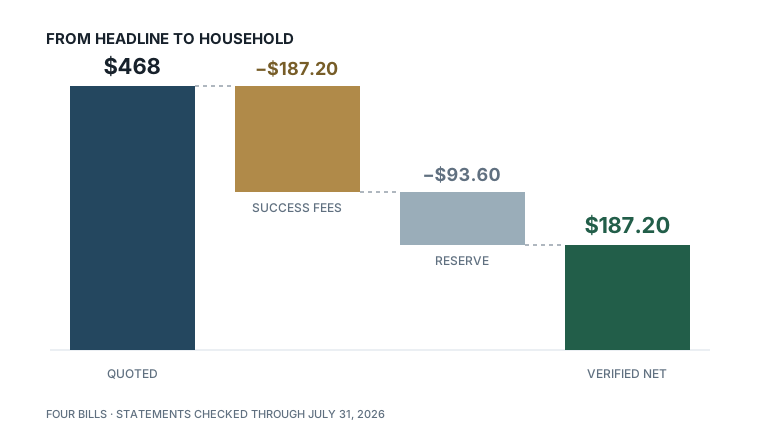
Rocket Money negotiated three of four submitted bills, quoting $468 in first-year savings. After its success fees and a temporary credit that did not lower the base rate, our verified net benefit was $187.20. The service saved time and money, but the largest marketing number was 2.5 times the amount the household could actually keep.
We began the case study on April 6, 2026, using four ordinary U.S. household bills: home internet, mobile service, satellite radio, and a security-monitoring plan. The accounts were current, outside initial trials, and eligible for submission in the app. We photographed the pre-negotiation statements, recorded plan details, and made no independent retention calls while the requests were open.
What we counted as savings
A lower recurring base price counted for the number of guaranteed months. A one-time account credit counted once. A service change counted only if the household accepted it without losing a feature it used. Taxes and government fees were excluded when they moved independently. Rocket Money’s fee was subtracted when charged, because gross savings cannot pay another bill.
That standard is stricter than multiplying a promising monthly change by twelve. Promotional rates can expire, and a provider can apply a credit while leaving the recurring plan untouched. We checked statements through July 31, 2026, then projected only discounts with written end dates.
| Bill | Before | Outcome | Quoted year-one savings | Fee | Verified net |
|---|---|---|---|---|---|
| Home internet | $84/mo | $69 for 12 months | $180 | $72 | $108 |
| Mobile | $126/mo | $10 × 12 credit | $120 | $48 | $72 |
| Satellite radio | $24/mo | $14 for 6 months | $60 | $24 | $36 |
| Home security | $39/mo | No change | $0 | $0 | $0 |
| Total | — | Plus $108 one-time internet credit | $468 | $187.20 | $187.20 |
The internet result was real, with a wrinkle
The internet provider reduced the recurring rate by $15 for twelve months and issued a $108 account credit after a service complaint was raised during the call. Rocket Money treated both as savings, producing $288 gross. We accepted that arithmetic because both appeared on statements, then subtracted the $115.20 success fee allocated to this result. Net value: $172.80 before the other bills are combined.
The wrinkle is renewal. The written offer returns to the prevailing rate after twelve months, not necessarily the old $84. A calendar reminder for March 2027 is part of the savings process. Without it, a quiet increase could erase part of the benefit. Rocket Money found the discount; it did not make the price permanent.
Mobile and radio: smaller than they looked
The mobile account received twelve $10 loyalty credits while retaining its data plan. That was straightforward: $120 gross, $48 fee, $72 net. The first two credits appeared correctly. The radio plan fell by $10 for six months, worth $60 gross and $36 net after a $24 fee. Its confirmation email made the six-month boundary clear.
Together, those two wins generated $108 net. They were also concessions a patient customer might obtain by calling directly. The value of the service was avoiding hold time and negotiation, not access to a secret tariff. We logged 17 minutes reviewing submissions and messages; direct calls would likely have taken longer, but that counterfactual cannot be measured exactly.
The failed bill matters
The security provider declined to lower its $39 monthly rate. No fee was charged. A clean failure is better than a misleading plan downgrade, and Rocket Money did not claim savings. Still, the request took nine days to close. Anyone facing a near-term renewal should not assume the concierge will finish before the billing date.
Our full Rocket Money review scores the broader app, not just negotiation. This case study should not be used to predict a household’s result: provider, location, account tenure, plan, and previous discounts all change leverage.
How $468 became $187.20
The four bills produced $468 in accepted gross value: $360 of recurring reductions plus the $108 internet credit. At the fee percentage selected in our flow, Rocket Money charged $187.20. Net benefit was therefore $280.80. We then reserved $93.60 because only half of the six- and twelve-month promotional periods had appeared on statements by July 31. Our conservative verified-to-date and contract-backed figure is $187.20.
Both numbers are legitimate if labeled. $280.80 is the projected net first-year benefit if every documented discount runs as promised. $187.20 is what we were comfortable treating as realized and sufficiently verified at publication. “Savings” without a time horizon, fee, and verification date is too elastic to guide a decision.
Who should use it
Bill negotiation makes sense for a person who will not call, has eligible recurring services, understands the success fee, and is willing to review every proposed change. It is a poor fit when a plan has complex bundled benefits or when the customer is comfortable negotiating directly. Never approve a downgrade based only on monthly price.
Read our Rocket Money versus YNAB comparison if the larger question is app choice. For the most recent cross-app evidence, the 90-day Q3 benchmark separates negotiation convenience from daily budgeting performance.
Frequently asked questions
How much does Rocket Money charge for bill negotiation?
The service charges a share of reported savings, with terms shown before submission. Our 2026 test used a 40% fee; readers should confirm their own percentage and billing timing.
Did all four bills go down?
No. Internet, mobile, and satellite radio produced accepted value. The home-security provider made no change, and Rocket Money charged no fee for that attempt.
Can I negotiate the same bills myself?
Often, yes. The concierge primarily saves time and handles the conversation. A direct retention call may obtain similar offers without a success fee.